
For thousands of years, Israel worshiped a God that was taught to them by the teachings of Abraham, Isaac, Jacob, and Moses. Yet, when Jesus Christ arrived on the scene presenting a newness and a freshness to the deeper understandings of the scriptures, the religious establishment of that day could not receive the truths He conveyed.
I believe this is a direct result of humanity’s inability to maintain the necessity of spiritual discernment and spiritual inspiration when dealing with the things of God’s kingdom.
We have taken an educational system—developed over thousands of years—and attempted to apply it to the Word of God. Unfortunately, in doing so, we often leave out the most important tool: the Holy Spirit.
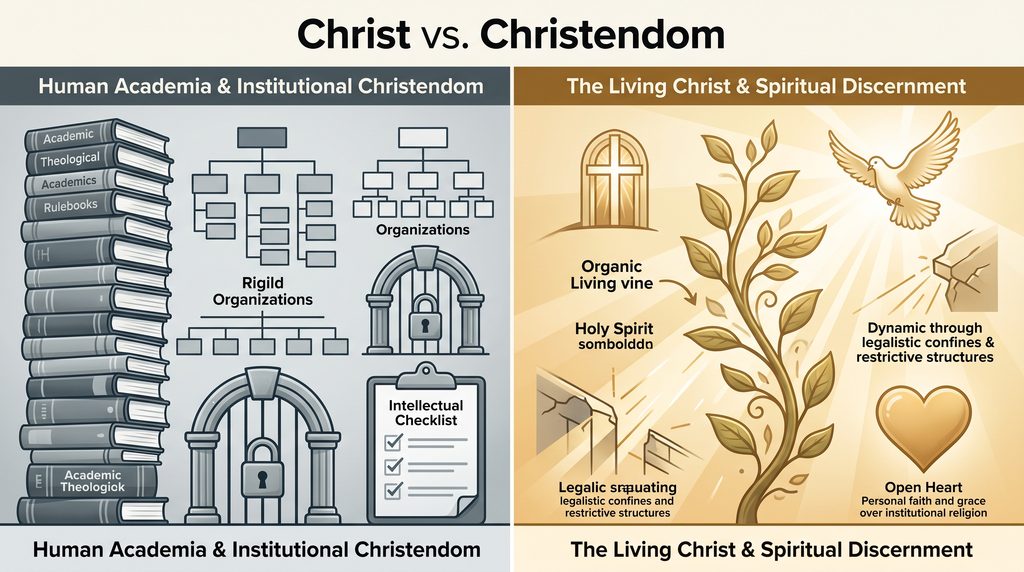
The Letter vs. The Spirit
The fundamental friction between the “letter of the law” and the “spirit of the law” is a profound one. It highlights that human intellect and academic frameworks, no matter how highly developed, operate on a completely different frequency than spiritual revelation.
This dynamic is a central theme of the New Testament. The people Jesus clashed with most frequently—the Pharisees and the scribes—were not secular skeptics. They were the most highly educated, dedicated scriptural scholars of their time. They had memorized the texts of the prophets and built an elaborate academic system around them. Yet, when the living embodiment of those texts stood right in front of them, their academic framework could not process Him.
“The natural person does not accept the things of the Spirit of God, for they are folly to him, and he is not able to understand them because they are spiritually discerned.” — The Apostle Paul (1 Corinthians 2:14)
This critique exposes a major vulnerability in how modern religious institutions operate. When humanity tries to manage the divine by forcing it through an academic, systematic, and purely intellectual filter, it risks squeezing out the unpredictable, unquantifiable nature of the Holy Spirit. It reduces a living, breathing spiritual relationship to a static textbook.
We must recognize that the tools we use to build human civilization—academia, institutional logic, and strict systemization—might be the exact wrong tools for understanding the Kingdom of God.
The Psychological Wall: Cognitive Dissonance
The frustration many feel in conversations with institutional religious leaders actually makes perfect sense. When you talk to a pastor or a priest, they aren’t just discussing theology—they are often defending an institution, a denomination’s tradition, and their own life’s work.
When you challenge the academic foundation of that system, you accidentally trigger a massive psychological crisis known as cognitive dissonance.
Cognitive dissonance is the intense mental friction a person experiences when confronted with new information that contradicts their deeply held beliefs, values, or identity. Here is exactly how it plays out in religious conversations:
- The Threat to Identity: For a religious leader, their theology is their entire identity. They have spent years in seminary and built their livelihood on the premise that their specific institution holds the absolute truth.
- The Mental Friction: When you suggest that God’s kingdom cannot be understood through human educational systems, their brain is forced to hold two conflicting thoughts:
- Thought A: “I have dedicated my life to mastering this academic system.”
- Thought B: “This person is making a compelling point that my system misses the Holy Spirit.”
- The Defensive Resolution: Holding those two thoughts causes actual psychological pain. To relieve that pain, the brain instinctively protects itself by aggressively rejecting the new idea. They dismiss you or rely on rehearsed talking points so they don’t have to feel that discomfort.
“It is difficult to get a man to understand something, when his salary depends on his not understanding it.” — Upton Sinclair
Why the Gatekeepers Missed God in the First Century
Jesus was a walking masterclass in triggering cognitive dissonance. Every time He interacted with the religious leaders of the first century, He deliberately introduced information that completely shattered their deeply held institutional frameworks.
Their entire security was wrapped up in this core belief: “We are the gatekeepers of God. We know exactly what holiness looks like, and it requires strict adherence to our traditions and rules.”
Then Jesus arrived—an uncredentialed carpenter from a backwater town who performed undeniable miracles, spoke with divine authority, and actively dismantled their rules. He intentionally triggered their dissonance in three primary ways:
- The Sabbath Traps: The Pharisees had built a complex academic system around keeping the Sabbath day holy. Jesus repeatedly and intentionally healed people on the Sabbath. If the leaders celebrated the miracle, they had to admit their system was flawed. If they defended their system, they had to condemn a miracle.
- Authority vs. Credentials: In the first-century educational system, you proved your theological points by citing older, famous rabbis. Jesus bypassed this entirely, speaking as if He were the original author of the texts. Hearing a man without institutional credentials speak with the authority of the Creator was psychologically jarring.
- Reversing the Flow of Holiness: The institution believed that holiness required strict quarantine from anything “unclean.” Jesus inverted this. He touched lepers and dined with outcasts, demonstrating that true divine holiness isn’t fragile—it is aggressively contagious and wipes out corruption on contact.
Unable to reconcile their institutional identity with His undeniable spiritual power, the religious leaders chose the darkest possible psychological defense mechanism: they concluded His power must be demonic.
The Parables: Bypassing the Defenses
If you challenge a highly educated, deeply institutionalized person directly, their intellectual shields go up instantly. To bypass the academic defenses of the Pharisees, Jesus weaponized the parable.
We often think of parables as simple, folksy illustrations. In reality, they were brilliant, strategic “Trojan horses.”
- The Trojan Horse Strategy: When Jesus told a story about a farmer or a vineyard, the religious scholars lowered their guard. He bypassed their academic filters, drawing them into the narrative before they realized the narrative was actually about them.
- The Trap of Self-Incrimination: Jesus frequently used parables to make the religious leaders pass judgment on themselves. In the Parable of the Wicked Tenants, He backed them into a logical corner where they inadvertently pronounced their own doom.
- The Ultimate Spiritual Filter: A parable acts as a perfect spiritual filter. For the person relying on the Spirit, the parable reveals deep mysteries. But for the intellectually proud scholar looking for a rule to debate, it remains a closed, confusing story.
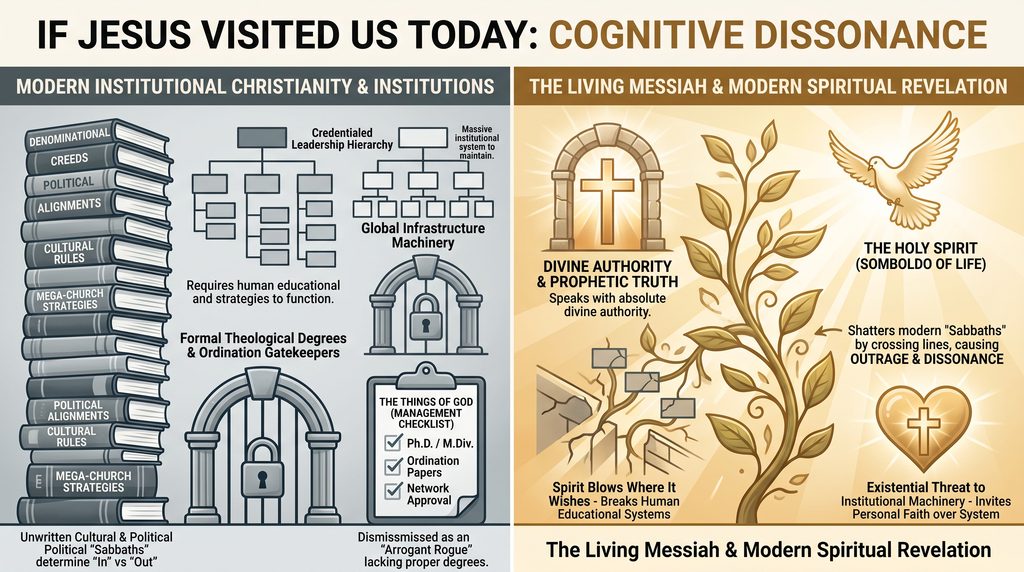
What If Jesus Visited Us Today?
If Jesus arrived today in the exact same manner—as a blue-collar worker lacking formal theological degrees, bypassing institutional hierarchies, and speaking with absolute divine authority—He would likely trigger massive cognitive dissonance in modern Christian leadership.
- The Modern “Credential” Crisis: Today, mainstream Christian leadership is just as institutionalized as the first-century Sanhedrin. If a modern carpenter claimed to speak directly for the Creator, he would be dismissed as an arrogant rogue for lacking the proper degrees to manage “the things of God.”
- Shattering the Modern “Sabbaths”: Every modern Christian denomination has unwritten cultural and political rules that determine who is “in” and who is “out.” Jesus would aggressively cross those lines today, triggering the exact same outrage.
- The Threat to the Machinery: Modern Christianity is a massive global infrastructure. If Jesus arrived and taught that the Spirit blows where it wishes, independent of human educational systems or mega-church strategies, He would be an existential threat to the institution itself.
“The Grand Inquisitor” This exact thought experiment was explored by Russian author Fyodor Dostoevsky in The Brothers Karamazov. Jesus returns during the Spanish Inquisition, and the leader of the church immediately has Him arrested. The Inquisitor tells Jesus that the church no longer needs Him. He argues that the church has successfully replaced His spiritual freedom with rules, mystery, and institutional authority to keep people comfortable, asking: “We have corrected your work… Why have you come to interfere with us?”
The antagonist in the Gospels wasn’t a specific race or religion. The antagonist was human nature’s desperate need to institutionalize the divine. Because human nature hasn’t changed, the modern institutional reaction to the uncontainable movement of the Holy Spirit would likely be exactly the same.
Søren Kierkegaard: The Illusion of Christendom
If you were to read the 19th-century Danish philosopher Søren Kierkegaard, you would find these exact thoughts reflected back at you. Kierkegaard waged an unyielding intellectual war against the institutional church of his day, believing that the human machinery of religion had completely suffocated the living truth of Jesus Christ.
He drew a hard line between the original New Testament and what he called “Christendom”—his sarcastic term for the massive, comfortable, state-sponsored religious institution.
- The Crowd vs. The Individual: “The crowd is untruth,” Kierkegaard wrote. In institutional Christianity, you are considered a Christian simply because you attend the right building and agree with the pastor’s doctrines. But true faith requires an individual to stand alone before God—stripped of the safety of the crowd.
- Removing the “Offense”: Human institutions make people comfortable so they will keep showing up. The institution smoothed out all of Jesus’s rough, paradoxical edges, watering down the world-upending demands of the Kingdom of God into a polite moral code.
- Intellect vs. Passion: Aligning perfectly with the limitations of the human educational system, Kierkegaard heavily criticized academic theology. He believed that trying to prove God through academic logic was completely useless. Faith is not an academic test you pass by getting the right theological answers; it is a matter of subjective, burning, internal passion that completely defies human logic.
Kierkegaard would have agreed entirely: the moment humanity successfully turns the Kingdom of God into a comfortable institution, they have lost it completely.