The end times will be like the days of Noah!
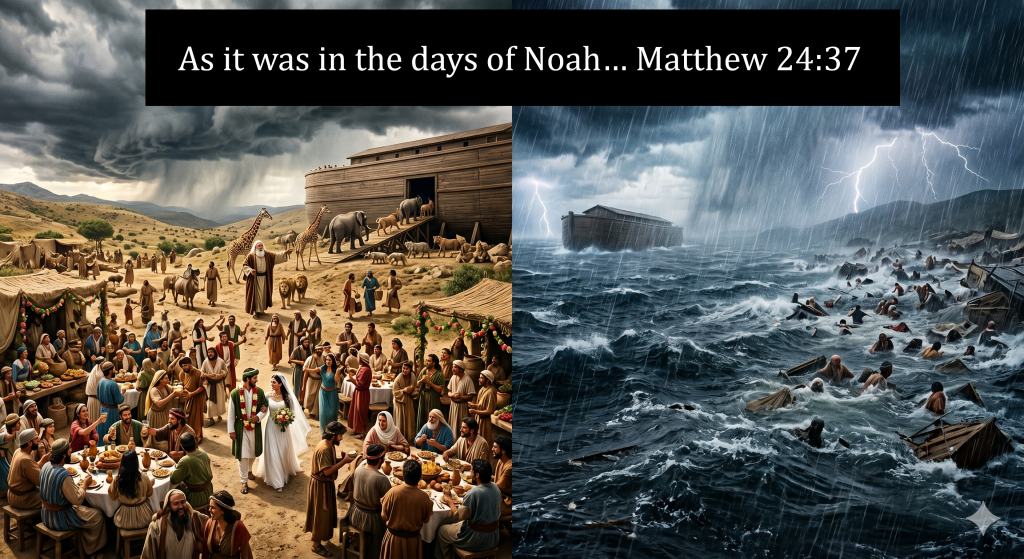
36 No one knows about that day or hour, not even the angels in heaven, nor the Son, but only the Father. 37 As it was in the days of Noah, so will it be at the coming of the Son of Man. 38 For in the days before the flood, people were eating and drinking, marrying and giving in marriage, up to the day Noah entered the ark. 39 And they were oblivious, until the flood came and swept them all away. So will it be at the coming of the Son of Man. Reference scriptures: (Genesis 6:1–7; Mark 13:32–37; Luke 12:35–48)
This passage from the Gospel of Matthew serves as the foundational text for the “days of Noah” comparisons. It delivers a profound warning about the sudden, unannounced return of Christ and the spiritual danger of becoming entirely consumed by the rhythms of ordinary life.
Breakdown of Matthew 24:36-39
The Absolute Uncertainty of Timing (Verse 36)
The text explicitly states that no one—not humanity, not the angels, nor even the Son—knows the day or hour of the end, save for God the Father alone. Because the timeline is entirely hidden, trying to predict the exact moment is futile. Instead, this uncertainty mandates a state of constant spiritual readiness rather than last-minute preparation.
The Peril of Ordinary Distractions (Verses 37-38)
Christ draws a direct parallel to the days of Noah, noting that people were busy “eating and drinking, marrying and giving in marriage.” These activities are not inherently sinful; rather, they are the mundane, standard operations of human existence. The danger highlighted here is allowing the necessary routines of daily life to become complete distractions, blinding people to the overarching spiritual reality and the approaching judgment.
The Tragedy of Obliviousness (Verse 39)
The people of Noah’s time were not just wicked; they were entirely oblivious right up until the door of the ark closed and the waters rose. This verse illustrates that a society can be functioning perfectly on a physical, economic, and social level while being entirely bankrupt and blind on a spiritual level. The tragedy is that their lack of awareness made the flood’s destruction absolute.
Modern Parallels: The World Today
There is a stark, direct parallel between the biblical “days of Noah” and the modern world. Just as the people of Noah’s time were caught completely unaware by the flood while living their daily lives, modern society is similarly distracted, entrenched in sin, and oblivious to impending judgment.
The Exaltation and Normalization of Sin
Just as Genesis 6 describes the pre-flood world’s thoughts as “only evil continually,” modern society has normalized and even worshiped sin. Citing 2 Timothy 3:1-5, the traits of “perilous times” are evident today. In the days of Noah, humanity had increased in deep-seated wickedness—and with today’s global population of 7.8 billion people, that same level of moral decay is prevalent.
The Illusion of Normalcy and Sudden Judgment
God’s judgment is often sudden and instantaneous. Historical and biblical examples—such as the destruction of Sodom and Gomorrah, the plagues of Egypt, and the parable of the Rich Fool (Luke 12)—illustrate that one’s life can be demanded at any moment. Christ’s return will catch the world by surprise, much like a thief in the night, leaving no time for people to amend their ways.
The Weaponization of Distraction
The devil intentionally uses the busyness of the modern world to keep people away from God. Obsessions with material possessions, social media, entertainment, and keeping up with trends are framed as dangerous distractions. Many people, including believers, become so consumed with daily life that they forget this world is not their home. The call to action is clear: “As Christians, we must be different.” Believers must actively resist these cultural tactics, prioritize their relationship with God, and remain spiritually alert.
God’s Patience and the Urgent Call to Repentance
Despite the wickedness of Noah’s generation, God showed immense patience, giving them 120 years to repent while Noah built the ark and preached. They responded with mockery. Similarly, the Gospel of salvation has been preached across the globe for over 2,000 years, yet many continue to ignore it. Still, God’s long-suffering nature means He is willing to forgive any sin if a person repents.
The Call to Absolute Obedience
Noah found grace in God’s eyes because he was a just and righteous man. God provided highly specific instructions for building the Ark (e.g., using gopher wood, exact dimensions of 300x50x30 cubits). Total obedience was required for Noah’s survival. Obeying God can often invite mockery, but modern believers must be willing to walk with God even if it means walking alone.
The Scale and Complexity of the Pre-Flood World
It is a common assumption that the pre-flood world was sparsely populated and primitive. However, biblical texts suggest a highly advanced, massive, and ultimately corrupt global civilization.
- Exponential Population Growth: Genesis records lifespans of 800–900+ years. With centuries of extended fertility and high birth rates, demographic compounding could have theoretically sustained a pre-flood population in the billions.
- A Pristine Environment & Genetics: Genesis describes the earth being watered by mist rather than rain. An unpolluted atmosphere, nutrient-dense soil, and the absence of genetic degradation would have naturally supported long, healthy lives.
- Rapid Technological Advancement: Genesis mentions early city-building, metallurgy, and musical instruments. Because master craftsmen could live for centuries, knowledge did not fragment across generations; they had hundreds of years to perfect and teach their trades.
- Systemic Moral Collapse: The “great” and “continual” wickedness described in Genesis 6 typically requires complex, established societies and hierarchies to flourish, not just small, isolated tribes. This advanced capability masked an underlying moral instability.
Jesus Christ: The Ultimate Ark and Hidden Pattern
The physical ark built by Noah was a symbolic shadow of a greater spiritual reality. Jesus Christ is the true Ark of Salvation. Just as Noah and his family had to get into the physical boat before the flood, believers today must “stay put” in Christ to escape the sudden judgment of His return.
The Bible repeatedly tells this same core story across hundreds of years and different authors. These Old Testament accounts (Typology) deliberately foreshadow the life, suffering, and resurrection of Jesus Christ:
| Old Testament Figure | Key Story Elements | Parallels to Jesus Christ |
| Joseph | Beloved son, hated by brothers, sold for silver (20 pieces), falsely accused, rose to be second-in-command to save Egypt/Israel. | Beloved Son of God, rejected by His people, sold for 30 pieces of silver, suffered, resurrected to supreme authority to offer salvation. |
| David | A shepherd who defeated the giant enemy (Goliath) with a stone. Hunted and persecuted, wrote Psalm 22 (“My God, why have you forsaken me?”). | Jesus is the “stone the builders rejected.” He defeated the ultimate enemies (Satan, sin, death) and quoted Psalm 22 on the cross. |
| Isaac | Abraham’s beloved, only son. Abraham was asked to sacrifice him. Isaac carried the wood up the mountain; God provided a substitute ram. | God’s only beloved Son. Jesus carried His own wooden cross up the mountain. God did not stop this sacrifice; Jesus became the provided Lamb. |
| Jonah | Swallowed by a giant fish and remained in its belly for three days and three nights before being “resurrected” to save Nineveh. | Jesus explicitly stated He would spend three days and nights in the earth before resurrecting to offer salvation to the world. |
| Moses (The Exodus) | Led the Israelites from slavery in Egypt through the parted Red Sea to freedom, destroying Pharaoh’s army in the water. | Passing through the water represents baptism—drowning the old life of slavery to sin (Egypt/Pharaoh) and emerging into new life and freedom. |
| Melchizedek | A mysterious “King of Salem” (Peace) and priest who brought bread and wine. He had an eternal priesthood, unlike regular priests. | Jesus is the Prince of Peace and the ultimate High Priest who offered one final sacrifice for all sins, eliminating the need for middlemen. |
| Samson | Possessed supernatural strength but was betrayed, blinded, and made to look weak and powerless. | Jesus appeared defeated on the cross, but like Samson, His greatest victory (destroying the enemy) was achieved through His death. |